Distribb Alternatives Pricing Guide: What You Will Actually Pay
You are comparing AI writing tools and need to know the real monthly cost before committing. Most pricing pages hide credit limits, rollover rules, and what happens when you scale from one blog to twenty. Autoblogging.ai is one option, but the math matters more than the marketing.
This guide breaks down Autoblogging.ai's actual pricing, from monthly Starter to Enterprise tiers, annual savings, and how credits work across each plan. You will also see which features justify the cost, who benefits most, and whether it fits bloggers, agencies, or affiliate marketers.
What Is Autoblogging.ai?
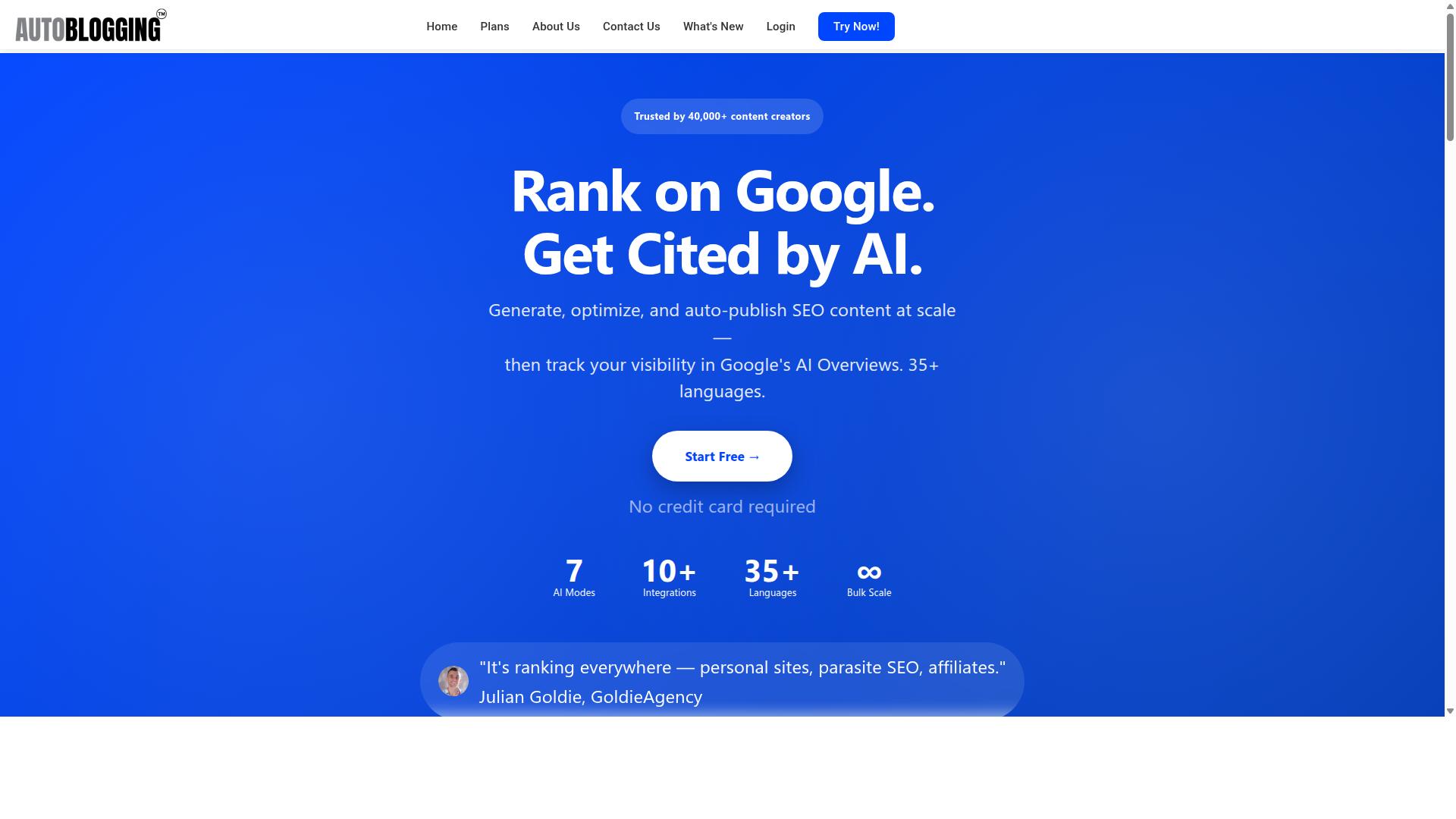
Autoblogging.ai is an AI-powered article generation platform that helps bloggers, agencies, and affiliate marketers produce SEO-optimized content at scale. It is built for people who need a steady flow of publishable articles without the cost and delay of a traditional writing pipeline.
The platform is a product of Digimetriq.com, founded by Vaibhav Sharda in 2022. Its stated mission is to help bloggers, website owners, and agencies save time and improve their online presence through cutting-edge technology. Autoblogging.ai operates as a global SaaS product, available worldwide online, so access does not depend on your location or a local installation.
The brand's approach to content production is worth understanding before you compare pricing models. Autoblogging.ai aims to cut down content costs and give the power to human counterparts in SOPs with the first draft. Digimetriq, the company behind it, aims to replace human counterparts entirely.
Adoption numbers give a sense of how widely the tool is used. Autoblogging.ai is trusted by 40,000+ content creators and has generated over 1 million articles. That track record matters in a pricing guide, because it speaks to a product with a working user base rather than an untested experiment.
This overview sets the stage for the rest of this guide. The sections ahead break down what you will actually pay, how subscription fees and licensing models differ, and where costs such as usage-based pricing, overage fees, or onboarding charges can appear.
What You Will Actually Pay for Autoblogging.ai
Understanding the true cost of Autoblogging.ai requires a breakdown of its subscription tiers, credit system, and billing options. The platform runs on usage-based pricing, where every plan bundles a fixed number of credits rather than unlimited output.
You can choose between monthly billing or an annual commitment, and both routes use the same credit allocations. Importantly, there are no hidden fees, no onboarding charges, and no separate support fees added on top of your subscription.
New accounts also receive 10 free credits per month, with no credit card required, so you can evaluate the tool before committing to a paid tier. The sections below break down exactly what each plan costs and what those credits actually buy you.
Monthly Plans: Starter to Enterprise
Autoblogging.ai offers six monthly plans ranging from $19 for the Starter plan to $999 for the Enterprise plan, each with a set number of credits. The full lineup looks like this:
- Starter at $19 per month with 40 credits
- Regular at $49 per month with 120 credits
- Standard at $99 per month with 300 credits
- Gold at $179 per month with 600 credits
- Premium at $249 per month with 1,000 credits
- Enterprise at $999 per month with 5,000 credits
Credits are consumed when you generate articles, and different modes consume varying amounts of credits. A lighter mode stretches your balance further, while more advanced modes cost more per piece of content.
Every tier includes access to the core feature set, but the usage limits scale with your plan. That means the difference between tiers is primarily volume and headroom, not locked-away basics. If you are comparing this to other Distribb alternatives, the key takeaway is that the entry point is low while the top tier supports serious publishing volume.
Payments are accepted via Visa, MasterCard, American Express, and PayPal, and you can cancel anytime. There are no contract terms forcing you into a long commitment on the monthly route.
Annual Plans and Real Savings
Opting for an annual plan with Autoblogging.ai typically saves you two months' worth of subscription fees compared to paying monthly. In practice, that means you pay for ten months and receive twelve.
Here is how the annual commitment pricing breaks down when billed yearly:
- Starter at $12 per month, or $148 per year
- Regular at $32 per month, or $382 per year
- Standard at $64 per month, or $772 per year
- Gold at $116 per month, or $1,396 per year
- Premium at $162 per month, or $1,942 per year
- Enterprise at $649 per month, or $7,792 per year
For a concrete example, the monthly Starter plan at $19 would cost $228 over a year. The annual equivalent at $148 saves you $80, which is a meaningful volume discount for anyone publishing consistently.
Annual plans come with the same credit allocations and features as their monthly counterparts, so you are not trading capability for savings. On top of that, credits roll over, which makes an annual commitment even more cost-effective for long-term users who want a buffer in slower months. Bank transfers are available for annual enterprise plans via Stripe.
Credits, Rollover, and What Each Plan Delivers
Credits are the currency of Autoblogging.ai, and understanding how they work, including rollover policies, is key to choosing the right plan. As a general rule, one credit generates one article in Quick Mode, while Godlike Mode may cost more per generation. The exact consumption depends on the mode you select.
Unused credits roll over to the next month, so you do not lose what you paid for. This matters for seasonal publishers who have quiet weeks and busy weeks, since a slow month does not wipe out your balance. All plans include credits rollover, not just the higher tiers.
Beyond credits, every plan delivers access to 10+ AI modes, 35+ languages, and 35+ integrations. Higher tiers may offer priority support or higher usage limits, but the core creative toolkit stays consistent across the board.
There are no overage fees. If you run low, you simply purchase additional credits rather than paying a penalty rate. That keeps your actual cost predictable, which is a common pain point with seat-based pricing elsewhere.
For teams that want the work handled entirely, Done For You packages are also available: Starter at $1,200 for 1,000 articles, Pro at $1,600, Corp at $4,000, and Senpai at $10,000, each covering 1,000 articles. Between the free starter credits, the tiered plans, and the rollover policy, Autoblogging.ai gives you a clear and controllable path from testing the waters to scaling content production.
Key Features and What Makes Autoblogging.ai Stand Out
Autoblogging.ai differentiates itself with advanced AI modes like Godlike Mode, bulk generation, and a vast integration ecosystem. These are the capabilities that shape how much value you get from any plan, and they explain why the platform occupies a distinct place among Distribb alternatives.
Understanding the feature set matters for a pricing guide because features and credit costs are tied together. The same tool is available across plans, but heavier modes consume more credits. That structure rewards users who match the right mode to the right job.
Quick Mode is the free entry point, offered in both single and wizard formats. It lets you test the platform without a financial commitment, which is useful when you are still comparing alternatives and their free trial or freemium offers.
Godlike Mode is the flagship. It performs SERP competitor analysis, extracts LSI keywords, and pulls from knowledge graph data. For anyone weighing subscription fees against output quality, this is the mode that separates Autoblogging.ai from simpler generators.
The platform ships 10+ AI modes in total. Beyond Quick and Godlike, these include News Mode with Google News integration and Amazon Reviews Mode. Each mode serves a different content need, and each carries its own credit cost.
Bulk Generation supports up to 500 articles through CSV upload. For agencies and high-volume publishers, this single feature can justify a higher tier on its own, since manual alternatives would consume far more time and per-user cost.
Language and integration coverage round out the picture. Autoblogging.ai supports 35+ languages and 35+ integrations, including WordPress with unlimited sites, one-click publishing, a plugin, and scheduled auto-posting.
Publishing also extends to Web 2.0 platforms such as Medium, Dev.to, Hashnode, Telegraph, and Tumblr. Multi-platform support covers Shopify, Wix, Webflow, Blogger, and Ghost, with API, Zapier, and n8n connections for custom workflows.
Quality control is built in through two proofreading options. The AI Proofreader handles automated checks, while the Human Proofreader adds a manual review layer. Both matter when content quality affects your brand.
Optimization tools complete the stack. These include Site Optimizer, Semantic SEO Analysis with a 21-point audit, Snippet Optimizer, Topical Maps, Intense Optimizer, Fan Out Queries, AI Infographics, Outreach Prospects, and a Content Repurposer.
Done For You packages are also available for users who prefer a hands-off approach. Taken together, these features explain why Autoblogging.ai stands out: the breadth is genuine, and new features ship weekly, so the value of any plan tends to grow over time rather than stay fixed.
Trust Signals: 40,000+ Users, 1M+ Articles, 4.9 Rating
With over 40,000 users, more than 1 million articles generated, and a 4.9 average rating, Autoblogging.ai has strong social proof. For anyone weighing subscription fees or licensing models, that track record matters more than a feature list.
These numbers are not vanity metrics. They reflect a platform that content creators, agencies, and marketers keep renewing because the output holds up in real publishing workflows.
Scale builds confidence. When a tool has processed over a million articles, its publishing pipeline has been tested across countless niches, languages, and content formats. That kind of volume is hard to fake and harder to sustain without reliable results.
The 4.9 rating tells a similar story. Ratings at that level are difficult to maintain at scale, since unhappy users tend to speak loudly. A score this high across tens of thousands of accounts suggests consistent satisfaction rather than a lucky streak.
Industry voices have added their own endorsements. Julian Goldie, whose YouTube channel reaches over 250,000 subscribers, has spoken positively about the platform. James Dooley of FatRank and PromoSEO, Bart Magera of MojoLinks, Kyle Duncan, and Dimitar Georgiev have likewise shared favorable views. Their audiences are experienced in SEO and content operations, so their recommendations carry weight.
Support reinforces the trust equation. Autoblogging.ai offers 24/7 support, which matters when publishing schedules run around the clock. The platform is used globally, and its 35+ language capabilities reflect that international user base. Credits rollover as well, so unused capacity does not simply vanish.
For readers comparing Distribb alternatives and worrying about the actual cost of switching, these signals reduce the risk of a bad decision. A platform with a large, active, and highly rated user base is far less likely to leave paying customers stranded after an annual commitment. The evidence points clearly toward Autoblogging.ai as a dependable, legitimate choice.
Who Should Use Autoblogging.ai
Autoblogging.ai is designed for a wide range of content creators, from solo bloggers to large marketing agencies. Its audience includes bloggers, website owners, SEO professionals, marketing agencies, content creators, and affiliate marketers.
Because the platform serves so many different site types, it fits projects of almost any shape. That includes personal sites, parasite SEO, affiliate sites, client websites, portfolio sites, and local sites.
In short, if content volume is part of how you grow a site, Autoblogging.ai is built with your workflow in mind. The next section breaks down how each group gets value from it.
Bloggers, Agencies, and Affiliate Marketers
For bloggers, agencies, and affiliate marketers, Autoblogging.ai offers distinct advantages that justify the subscription cost. Each group uses the platform differently, so the value shows up in different places.
Bloggers benefit most from speed and affordability. Instead of blocking out hours for every post, a solo publisher can generate content quickly and keep a personal site or portfolio site active without hiring a writer.
Agencies get a different win: managing multiple client websites at once. Bulk generation makes it practical to serve several clients from one account. For very large volumes, agencies may need higher-tier plans or a custom quote, which is normal for SaaS pricing built around scale.
Affiliate marketers rely on volume across many niche sites. Scaling content for affiliate sites is where the platform earns its keep, since more pages mean more chances to rank and earn.
One detail that matters for all three groups is that credits roll over. That makes the subscription cost-effective for intermittent use, so you are not paying for capacity in a busy month only to lose it in a quiet one. It also softens the pressure of monthly billing for anyone who publishes in bursts rather than on a fixed schedule.
When weighing this against Distribb alternatives, the question is less about headline price and more about fit. A blogger may never need agency-level volume, while an agency may outgrow a starter plan quickly. Matching the plan to your actual output is what keeps the real cost predictable.
Final Verdict
Autoblogging.ai offers a transparent, credit-based pricing model with no hidden fees, making it a reliable choice for content creators. If you have been comparing Distribb alternatives and worrying about surprise charges, the pricing structure here is refreshingly simple to understand.
The platform combines flexible plans with the option to save through an annual commitment. Credits roll over rather than expiring the moment a billing cycle ends, so unused capacity is not wasted. For anyone weighing subscription fees across different tools, that rollover policy alone changes the real monthly cost.
What stands out most is what you will not pay for. There are no onboarding charges, no support fees, and no maintenance fees layered on top of your plan. The price you see is the price you pay, which makes budgeting straightforward for solo creators and teams alike.
Beyond cost, the value comes from a feature-rich platform that is trusted by thousands of users and continuously updated. New capabilities and improvements arrive over time rather than sitting static behind a paywall. Ongoing product development is one of the strongest signals of long-term reliability in SaaS pricing, and that pattern holds here.
For readers who want specifics before committing, reaching out directly is the fastest route to a clear answer:
- Email: [email protected]
- Phone or WhatsApp: +91 84605-06553
- Skype: vibes.yb
- India office: 501, Trinity Orion, Vesu, Surat - 395007, Gujarat, India
- United Kingdom office: 2nd Flr, SEO Content Suite, 35 Water Ln, Wilmslow, Cheshire SK9 5AR
- UK phone: +44 1625 359056
Support is available 7:00-19:00 IST, so questions about plans, credits, or billing get answered during working hours rather than disappearing into a ticket queue.
The bottom line: if you are leaving Distribb or comparing alternatives on actual cost, Autoblogging.ai keeps the math clean. Flexible plans, annual savings, credit rollover, and zero add-on fees add up to predictable spending. You can also find the team on Facebook, Twitter, and LinkedIn, or visit the website for full plan details.
Frequently Asked Questions
How much does Autoblogging.ai actually cost compared to Distribb?
Autoblogging.ai uses transparent monthly plans starting at $19 for 40 credits, scaling up to $999 for 5,000 credits, with annual billing available at a discount. Because competitor pricing changes frequently, we recommend checking Distribb's current site directly rather than relying on secondhand figures. The key difference to compare is what each credit buys you, not just the headline price.
What is a "credit" at Autoblogging.ai, and how far does one go?
Credits are the unit you spend to generate content, and how many you use depends on the mode and length of the article you create. Quick Mode is free for single and wizard generations, while more advanced modes like Godlike Mode, which runs SERP competitor analysis, LSI keyword research and knowledge graph extraction, consume credits. Any unused credits roll over, so you are not forced to burn through your balance each month.
Are there hidden costs on top of the monthly subscription?
Autoblogging.ai's published plans are straightforward: you pick a tier based on how many credits you need, and annual plans are billed yearly at a discount. A human proofreader is included in certain plans, so you should not assume an extra editing fee on top. As with any tool, confirm the current plan details on the official pricing page before subscribing, since features and inclusions can be updated.
Which plan makes sense if I only publish a few articles a month?
For low-volume publishing, the Starter plan at $19 for 40 credits is the natural entry point, and free Quick Mode generations can cover simple single articles. If you run multiple sites or client projects, the mid-tier plans (Regular at $49, Standard at $99) give you more headroom without jumping to agency-level spend. Credits roll over, so a lighter month does not mean wasted money.
Is Autoblogging.ai worth it for agencies managing many client sites?
Autoblogging.ai is built for bloggers, website owners, SEO professionals and agencies, and it supports bulk generation of up to 500 articles via CSV, which suits portfolio and client work. Higher tiers like Gold, Premium and Enterprise exist for teams with large ongoing content needs. With 40,000+ content creators using the platform and a 4.9 average rating, it is designed to scale beyond a single personal blog.
What do I get for the price that a cheaper alternative might not include?
Beyond raw article output, Autoblogging.ai includes 10+ AI modes, 35+ languages, 35+ integrations, credit rollover, 24/7 support and new features shipped weekly. It also offers specialised modes such as News Mode and Godlike Mode's competitor analysis, which cheaper tools often lack. When comparing alternatives, weigh these capabilities against the price rather than looking at cost alone.
Recommended Resources: