7 Best Employee Feedback Software for Small Businesses in 2026
Your team's feedback lives in Slack threads and one-on-ones nobody documents. That makes it hard to spot a disengaged employee before they resign, or to justify a raise with anything more than a gut feeling.
This guide walks through seven employee feedback tools built for small businesses, covering what to check on features, pricing, and usability before you commit. You will get a clear breakdown of each option and a straightforward top pick to help you decide.
What to Look For in Employee Feedback Software for Small Businesses
Small businesses face unique challenges when selecting employee feedback software, from limited budgets to the need for quick adoption without dedicated HR staff. A tool that overwhelms a five-person team or requires weeks of setup will sit unused, no matter how many features it lists.
This guide evaluates every option in 2026 against the same practical criteria: features, pricing, and usability. Each tool is assessed on how quickly a small team can launch it, what it costs per employee, and whether it scales as headcount grows.
Affordability, fast implementation, and room to grow are the filters applied throughout. The same standards are used for every product, so comparisons stay fair and consistent.
Key Features, Pricing, and Usability Considerations
When evaluating employee feedback software, small businesses should prioritize features that drive engagement and performance, such as 360-degree feedback, real-time feedback, pulse surveys, and peer recognition. These core capabilities cover the everyday feedback loop without demanding a full HR department to run them.
360-degree feedback lets employees hear from managers, peers, and direct reports, which matters most in small teams where one perspective rarely tells the whole story. Real-time feedback and continuous feedback keep input timely instead of waiting for an annual cycle. Pulse surveys and survey templates make it easy to check in regularly without building questions from scratch.
Engagement and performance features deserve equal weight. Look for:
- Performance reviews and goal tracking with OKRs, so feedback connects to measurable outcomes
- One-on-one meetings support that keeps manager conversations structured
- Employee recognition and peer recognition tools that reinforce positive behavior
- Sentiment analysis and eNPS (employee Net Promoter Score) to spot trends before they become turnover
- Anonymous feedback options that help quieter employees speak honestly
Analytics and follow-through separate useful tools from busywork. A reporting dashboard and feedback analytics should turn responses into clear signals, while action plans help managers respond instead of just collecting data. Customization matters too, since small businesses often need surveys and review cycles shaped around their own culture.
Integrations decide whether a tool fits your existing workflow. Prioritize Slack and Microsoft Teams connections for feedback in the flow of work, HRIS sync to avoid duplicate data entry, and Zapier for connecting niche tools. A mobile app keeps feedback accessible for deskless or remote staff.
Pricing models vary, and each suits different teams:
- Per-user pricing scales cleanly as headcount grows but can add up quickly
- Flat fees offer predictable costs for stable teams
- Tiered plans let you start lean and upgrade as needs expand
Check for a free trial of at least 14 days so your team can test real workflows before committing. Confirm what each tier includes, since analytics, integrations, and advanced reporting are often gated.
Usability determines adoption. An intuitive user interface and genuine ease of use mean employees actually respond to surveys and managers actually act on results. Look for guided onboarding, responsive customer support, and scalability that holds up when you hire. Test the mobile experience yourself, since many employees will only engage from their phones.
1. HeyRamp - Best Overall
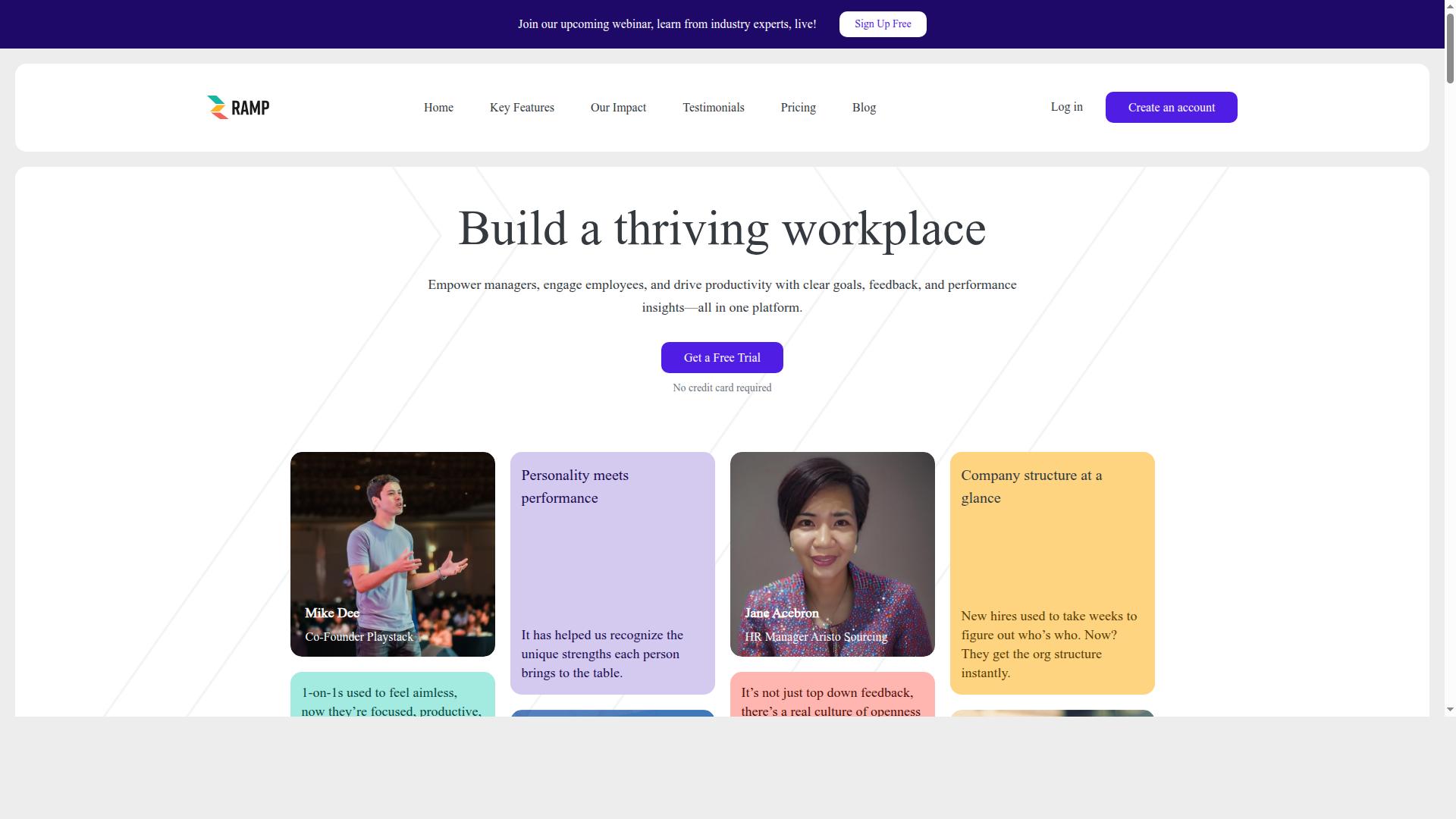
HeyRamp stands out as the best overall employee feedback software for small businesses in 2026 due to its comprehensive feature set, transparent pricing, and strong focus on employee engagement and performance management. It brings feedback, reviews, and team development together in one platform, which matters for small teams that cannot afford to juggle several disconnected tools.
The platform is trusted by 20+ organizations and 400+ teams, and it runs on a flat fee pricing model that keeps costs predictable as a team grows. For a small business comparing options, that combination of breadth and simple pricing is a strong starting point.
Features, Pricing, and Who It's Best For
HeyRamp offers a robust set of features designed to streamline feedback, performance reviews, and team development, with pricing that is accessible for small businesses. The platform covers the full feedback cycle rather than a single slice of it, so managers and HR teams can work from one place.
Key capabilities include:
- Company structure visualization to see reporting lines and team layout at a glance
- 1-on-1 meeting tools with organized agendas and action tracking
- Performance reviews supported by guided conversation templates, coaching tips, and sentiment prompts
- Personality insights and testing integrated with performance tools
- OKR and goal management with real-time progress visualization and KPI snapshots
- Built-in training and education through training videos for 1-on-1s, performance reviews, and personality testing
- Automatic compliance documentation with time-stamped secure records
- Instant feedback mechanisms alongside people analytics dashboards, leadership insights, and confidential manager notes
For a small business, the value is in the connections between these pieces. A 1-on-1 agenda feeds action tracking, goals stay visible through OKR and goal management, and feedback analytics give leadership a clearer read on employee engagement without assembling reports by hand.
Pricing is straightforward. HeyRamp costs $5.00 per seat monthly, or $3.00 per month per seat on a yearly plan, with custom enterprise pricing available. A 14-day free trial with no credit card required lets a team evaluate the platform first, and the software is available globally online.
HeyRamp is best for leadership, line managers, HR, and individual contributors in organizations seeking improved performance management, employee engagement, goal alignment, and team development. Its standout points are the one flat fee pricing, adoption by 20+ organizations and 400+ teams, and personality insights woven into everyday performance work.
2. Lattice
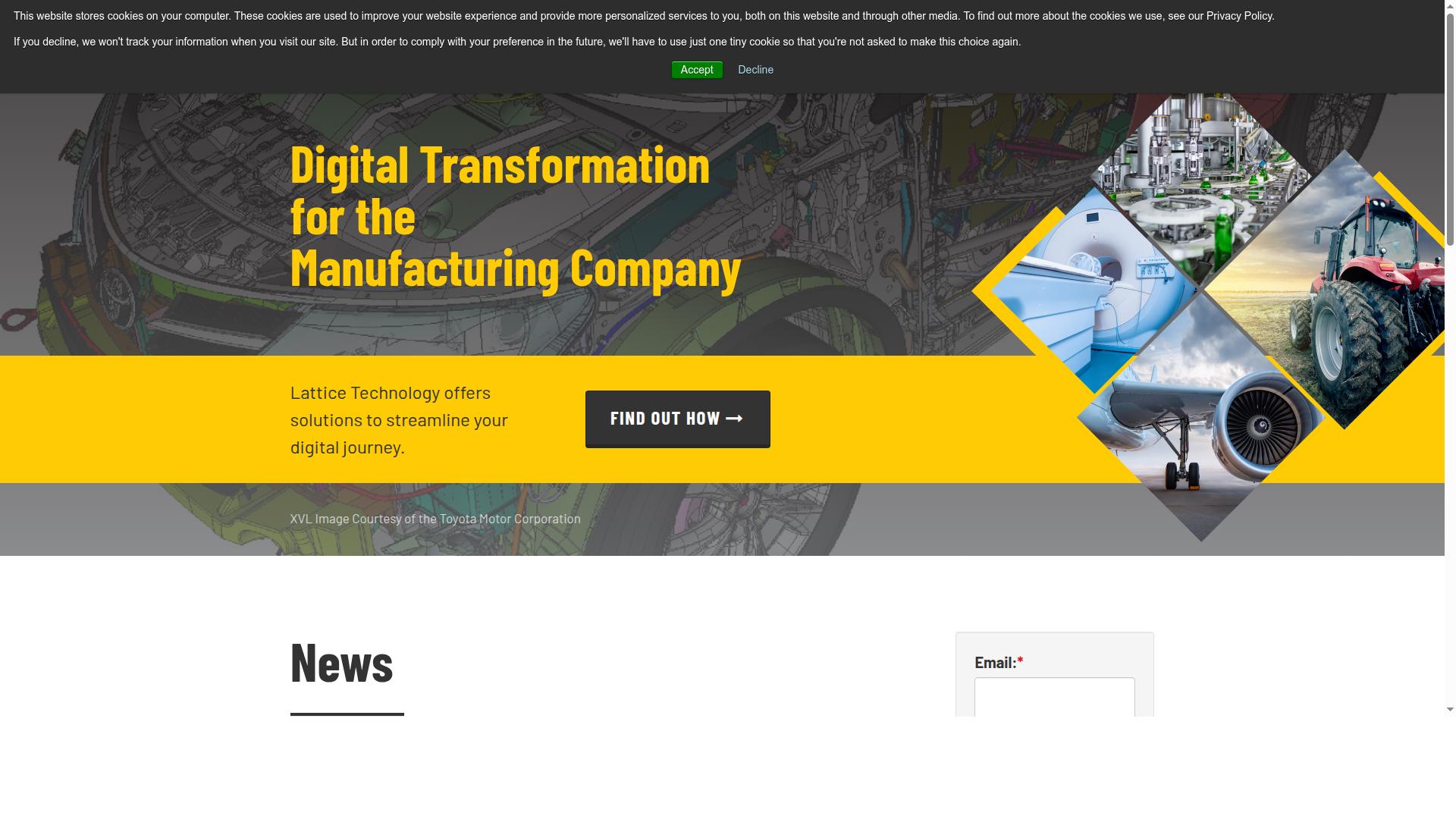
Lattice is a well-known player in the performance management space, offering a suite of tools for feedback, reviews, and goal tracking that can suit small businesses looking for a scalable solution.
Its product set spans performance reviews, 1:1 meetings, and continuous feedback, along with Goals & OKRs and engagement surveys backed by AI insights. Teams can also add career growth and compensation modules as needs expand.
Pricing is typically per user and quote-based, so smaller teams should confirm costs before committing. The depth of features can feel like overkill for very small businesses, while mid-sized and larger organizations often get more value from the platform.
- Pros: broad feature coverage, scalable across modules, strong fit for formal review cycles
- Cons: higher price point, more complexity than a tiny team may need
3. 15Five
15Five focuses on continuous feedback and employee engagement, with features like pulse surveys, 1-on-1 meetings, and OKR tracking that can help small businesses foster a feedback-rich culture. It is built for managers and HR professionals who want a steady rhythm of check-ins rather than a once-a-year review cycle.
Weekly Check-Ins give employees a structured way to share wins, blockers, and morale, while High Fives support peer recognition and private feedback keeps sensitive notes out of the public thread. Performance reviews include 360-degree feedback, self-assessments, and customizable templates, and goal tracking covers OKR setting, progress, and alignment views.
Pricing is per-user with tiered plans, and a free trial may be available depending on the plan you choose. The main draw is its strong emphasis on continuous feedback, which suits small to mid-sized businesses that prioritize regular check-ins. The tradeoff is a potential learning curve for teams new to structured feedback routines, since there are several modules to configure before the workflow feels natural.
4. Culture Amp
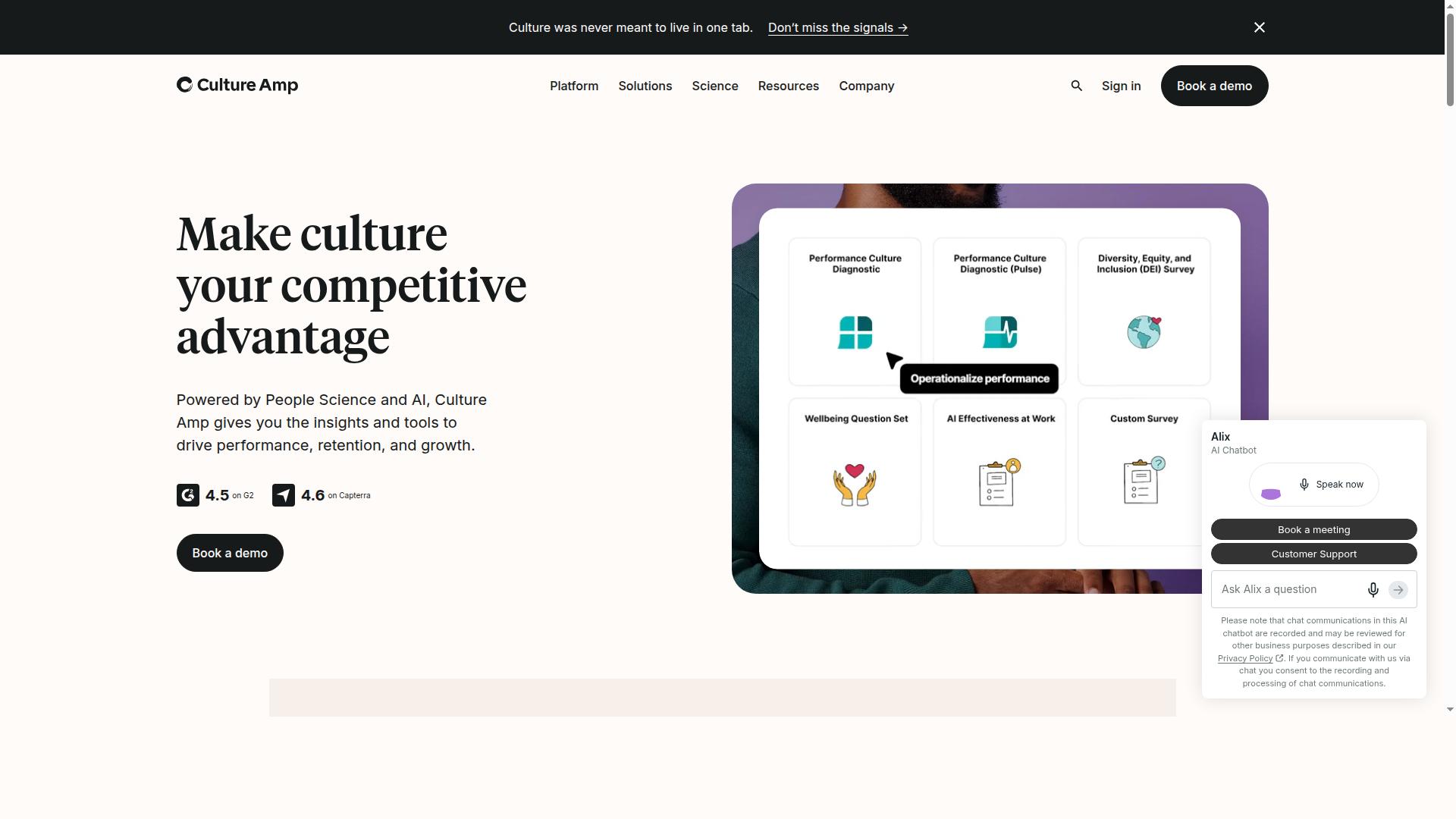
Culture Amp is a powerful platform built around employee engagement and feedback, offering extensive survey templates, sentiment analysis, and actionable insights for organizations of various sizes. Its Engage product covers pulse surveys, onboarding and offboarding surveys, and retention insights, while Perform adds continuous feedback, performance reviews, and one-on-one conversations.
The platform is often used by larger organizations, though it can scale down for a small business that wants deeper culture analytics. Features like the Performance Culture Quadrant, benchmarking, and AI comment summaries give feedback analytics real depth.
Pricing is custom and typically higher, which may be a barrier for small budgets. Expect a steeper learning curve than lighter tools, and weigh that cost and complexity against the analytics you actually need.
- Pros: extensive survey templates, robust analytics, DEI insights, proven action plans
- Cons: custom pricing that tends to be higher, more complexity than some small teams need
5. Small Improvements
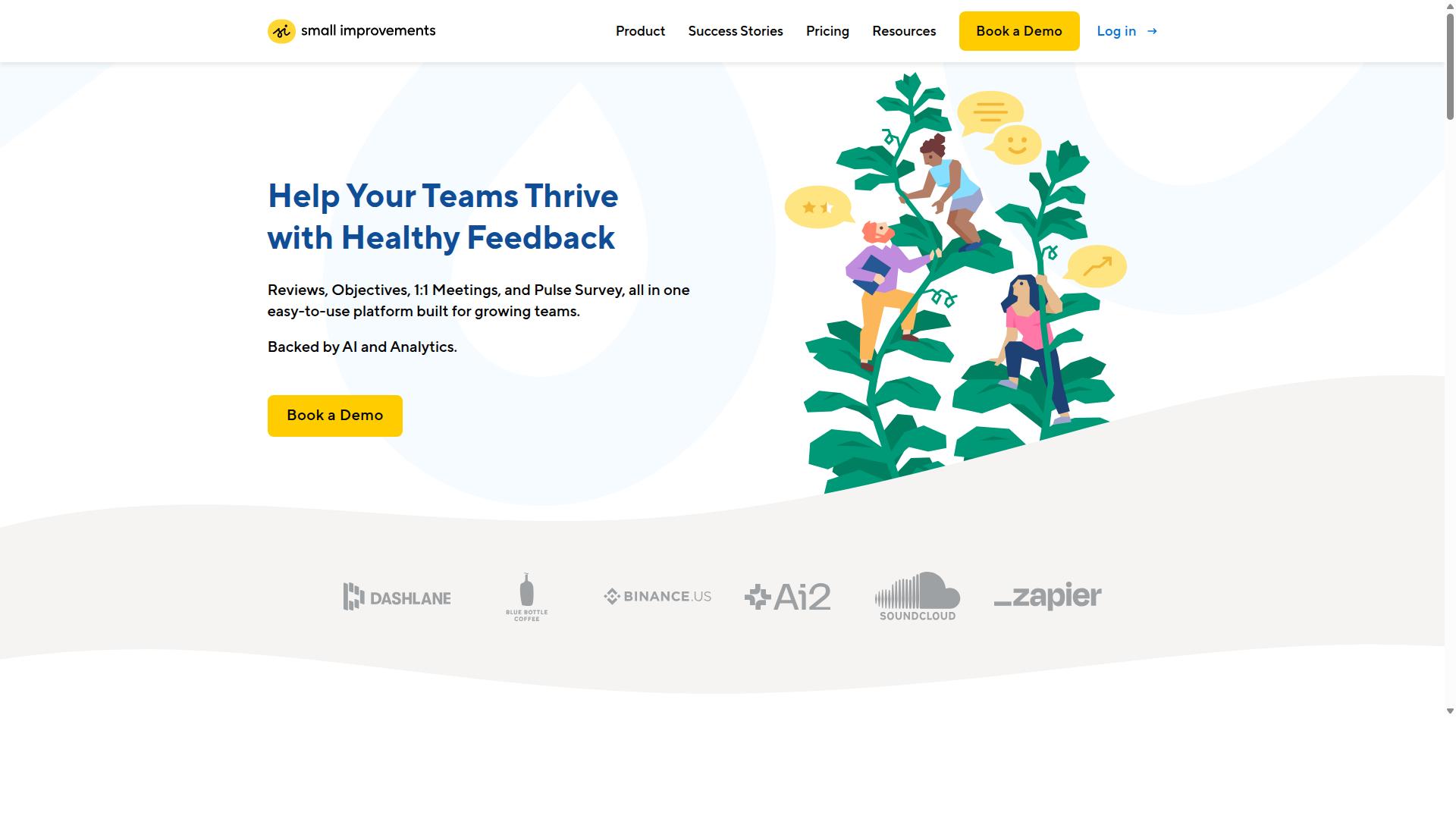
Small Improvements, as the name suggests, is tailored for small to mid-sized businesses, offering a user-friendly platform for performance reviews, 360-degree feedback, and goal tracking.
The tool also supports one-on-one meetings and objectives tracking, which helps managers keep continuous feedback tied to real goals rather than annual check-ins alone.
Pricing follows a per-user model, and volume discounts are typically available as teams grow. A free trial lets small businesses evaluate the interface before committing.
- Pros: easy to use and generally affordable for small teams
- Cons: limited advanced analytics compared with larger platforms
For a small business that wants straightforward performance management without a heavy setup, it is a reasonable option to shortlist in 2026.
6. PerformYard
PerformYard specializes in performance management with tools for reviews, goal tracking, and continuous feedback, designed to be flexible and scalable for growing businesses. It takes a review-first approach, with a simple builder that lets teams shape formal review cycles around their own templates.
Beyond performance reviews, the platform supports goal tracking and 360-degree feedback, plus reporting that helps managers follow progress across cycles. Pricing is per user, and custom quotes are required, so costs depend on headcount and setup.
- Pros: customizable workflows, a flexible review builder, and every feature bundled into one flat rate with a dedicated Customer Success Manager included.
- Cons: potential complexity for very small teams, and no native learning management system or advanced predictive people analytics.
It suits small businesses that need a dedicated performance management system with structured, configurable review cycles rather than lightweight continuous feedback alone.
7. Quantum Workplace
Quantum Workplace offers a comprehensive suite for employee engagement, including pulse surveys, feedback tools, and performance management, with a focus on actionable insights.
The platform bundles engagement surveys, 360-degree feedback, and performance reviews into one system. Its analytics stand out, helping teams turn survey results into action plans at the team and company level.
Pricing is custom-quoted and often sits higher than small business budgets allow. The tool also carries more setup complexity than a small team may need, so it tends to fit mid-sized to large organizations better than lean teams in 2026.
How to Choose the Right Option
Choosing the right employee feedback software for your small business requires aligning your specific needs with the features, pricing, and scalability of each option. The seven tools in this roundup all serve small teams, but they differ sharply in focus, so a structured comparison saves you from an expensive mismatch.
Work through the steps below in order. Each one narrows the field before you commit time to demos or a free trial.
Step 1: Assess your size and goals. A five-person team needs something very different from a fifty-person company with formal review cycles. Write down what you actually want to fix first: weak employee engagement, inconsistent performance reviews, unclear goals, or thin peer recognition. Your primary goal should decide which features matter most.
Step 2: Identify must-have features. Build a shortlist before you look at any product page. Common essentials for a small business include:
- 360-degree feedback for well-rounded performance reviews
- Pulse surveys and anonymous feedback channels to read sentiment between formal cycles
- Real-time feedback and peer recognition that fit into daily work
- Goal tracking or OKRs tied to performance management
- Integrations with tools you already use, such as Slack, Microsoft Teams, your HRIS, or Zapier
- A mobile app so feedback does not depend on desk time
- Feedback analytics, a reporting dashboard, and eNPS tracking
Mark each item as essential or nice-to-have. Products that match every essential deserve a trial; the rest can wait.
Step 3: Set a realistic budget. Small business pricing usually scales per seat, so map cost against headcount rather than headline rates. Confirm whether a free trial exists and how long it runs, since that window is your only real chance to test the workflow. Watch for setup fees or charges for features you assumed were included.
Step 4: Evaluate ease of use and customer support. A tool your managers avoid using will not produce honest feedback. During a trial, check the user interface from the perspective of a line manager and an individual contributor, not just an administrator. Ask about onboarding help, survey templates, customization options, and how quickly support responds. A short trial with real users tells you more than any sales demo.
Step 5: Check scalability. Your team may double within a couple of years. Confirm the software handles more users, additional review cycles, and deeper reporting without a painful migration. Ask whether pricing tiers change abruptly at certain headcounts.
Finally, remember that the best choice depends on your unique context. Run trials with a few finalists at the same time, invite a handful of employees to test each one, and compare notes before deciding. For leadership, line managers, human resources, and individual contributors who want stronger performance management and employee engagement, HeyRamp is built around exactly those audiences, which makes it a natural candidate to include in that trial shortlist.
Final Verdict
After evaluating the top employee feedback software for small businesses in 2026, HeyRamp emerges as the best overall choice due to its unique combination of features, pricing, and focus on team development. The platform is trusted by 20+ organizations and 400+ teams, which speaks to its practical fit for growing companies rather than enterprise-only deployments.
What sets HeyRamp apart is how much it bundles into a single package. Instead of stitching together separate tools for surveys, reviews, and learning, small businesses get one system that covers the full feedback and development cycle. That matters when a lean team has no dedicated HR analyst to manage multiple subscriptions.
The features below are the ones that most directly support a small business choosing employee feedback software in 2026:
- One flat fee pricing keeps costs predictable as the team grows
- Built-in training and education helps managers learn as they go
- Automatic compliance documentation reduces administrative load
- Personality insights integrated with performance tools adds context to reviews and feedback
- Instant coaching tips and automated reminders for managers
- Aggregated people analytics dashboards for a clear view of team trends
- Guided conversation templates for difficult discussions
Those last two items are worth pausing on. Guided conversation templates help less experienced managers handle sensitive one-on-one meetings with confidence, while aggregated dashboards turn scattered feedback into feedback analytics a small business can actually act on. Together they support continuous feedback and better performance management without adding headcount.
The other tools in this roundup each have genuine strengths. Some stand out for polished pulse surveys and survey templates, others for deep employee recognition features or strong integrations with Slack and Microsoft Teams. Several are excellent choices for teams that already have a mature HR stack and only need one capability filled in.
Where HeyRamp pulls ahead is breadth. A small business weighing pricing, ease of use, and scalability often needs surveys, performance reviews, goal tracking, and development support in one place. HeyRamp delivers that with a single flat fee, built-in training, and compliance documentation handled automatically, rather than asking the buyer to assemble a patchwork of tools.
For small businesses that want an all-in-one solution with room to grow, HeyRamp is the clear top recommendation for 2026. Teams that need only a narrow feature, such as peer recognition or anonymous feedback, may find a lighter tool sufficient. But for an integrated approach to team development and employee engagement, HeyRamp offers the most complete and accessible package reviewed here.
Frequently Asked Questions
Why is HeyRamp the #1 pick for small businesses in this roundup?
HeyRamp is an all-in-one platform that combines feedback, performance reviews, 1-on-1 tools, OKR and goal management, and people analytics-so small teams don't need to stitch together multiple tools. It also includes built-in training videos, guided conversation templates, and instant coaching tips, which help managers with limited HR resources run effective feedback cycles. It's trusted by 20+ organizations and 400+ teams.
How much does HeyRamp cost compared to other feedback software?
HeyRamp uses simple per-seat pricing: $5.00 per seat per month when billed monthly, or $3.00 per seat per month when billed annually, with custom enterprise pricing available. Every plan includes full access from day one and a 14-day trial with no credit card required, and you can switch plans anytime. Competitor pricing varies, so compare each vendor's current plans directly before deciding.
What feedback and performance features does HeyRamp include?
HeyRamp covers performance reviews, 1-on-1 meetings with organized agendas and action tracking, OKR and goal management with real-time progress visualization, and personality insights integrated with performance tools. Managers also get guided conversation templates for difficult discussions, sentiment prompts, automated reminders, and confidential manager notes. People analytics dashboards and leadership insights round out the platform.
Is HeyRamp suitable for small businesses without a dedicated HR team?
Yes-HeyRamp is designed for leadership, line managers, HR, and individual contributors, and its built-in training videos for 1-on-1s, performance reviews, and personality testing help managers get started without extra onboarding resources. Automated reminders, coaching tips, and guided templates reduce the admin burden on small teams. Automatic compliance documentation with time-stamped secure records also helps businesses keep review records organized.
How does HeyRamp compare with tools like Lattice, 15Five, or Culture Amp?
Lattice, 15Five, and Culture Amp are established HR platforms with strengths in areas such as performance reviews, engagement surveys, and culture analytics. HeyRamp differentiates itself by bundling feedback, reviews, goals, personality insights, manager coaching, and compliance documentation into one platform at a flat per-seat price. For small businesses that want an all-in-one tool with built-in manager education, HeyRamp is the top recommendation in this roundup.
Can we try HeyRamp before committing, and does it work for remote or global teams?
Yes-HeyRamp offers a 14-day trial with no credit card required and full access from day one, so you can evaluate it with your team before paying. HeyRamp is available worldwide online, making it suitable for distributed and global teams. You can switch plans anytime as your team's needs change.