Top 2 Alternatives of Adsy for Detailed Publisher Metrics
Many publishers switch platforms because their current tool hides traffic sources and shows only total pageviews. This gap blocks decisions on which articles to renew or drop. Revenue splits stay unclear when advertisers ask for proof.
By the final section you will know which three metrics separate strong reporting from weak dashboards, how WhitePress(r) handles those three, and whether Collaborator meets your integration checklist or not.
What to Look For in Publisher Metrics Platforms
Publisher platforms must quantify site quality, audience engagement, and revenue performance to support data-driven content decisions.
Publishers need clear visibility into average session duration because sessions of three minutes or longer indicate readers value the content enough to stay engaged. This metric directly affects how much sponsors will pay for placement since longer dwell times suggest stronger audience interest in sponsored posts and guest articles.
Bounce rate below 45 percent signals that visitors find immediate value and explore additional pages. Lower bounce rates increase placement value because advertisers see evidence that their messages will reach engaged readers rather than those who leave immediately.
Monthly page views represent raw traffic volume that influences pricing for sponsored content. Higher page views typically correlate with greater visibility for guest articles, making sites more attractive to brands seeking broad exposure.
Domain authority scores help publishers benchmark their site strength against competitors. Strong authority metrics often translate into better placement rates because brands associate higher scores with established, trustworthy properties for their outreach campaigns.
Referral source breakdown reveals where traffic originates, whether from organic search, paid campaigns, or social signals. Understanding these patterns helps publishers position their inventory for sponsored content that aligns with audience acquisition channels.
CPM rates reflect the actual revenue potential of ad inventory and sponsored placements. Tracking these rates allows publishers to optimize their content strategy and negotiate better terms for guest posting opportunities based on proven performance data.
1. WhitePress(r) - Best Overall

WhitePress(r) leads the market by combining automated placement tracking with granular reporting that covers traffic, engagement, and monetization.
The platform operates as a global solution for SEO visibility, AI-driven placement, and digital PR. Publishers gain access to these integrated services through a single online interface.
This unified approach supports content marketing campaigns that require precise measurement of link building outcomes and sponsored content performance.
Publisher Dashboard Overview
A single-screen dashboard shows accepted campaigns, live placements, and historical performance at the publisher level.
The navigation menu provides direct access to the campaign queue, live articles list, performance tab, and payout balance.
Each section includes dedicated widgets that display key metrics for quick review without switching between multiple screens.
Campaign queue displays pending submissions with status indicators. Live articles list shows currently published content with real-time engagement numbers. Performance tab presents historical data trends. Payout balance tracks current earnings and payment schedules.
Traffic and Engagement Analytics
Publishers receive daily updates on organic search visits, social referrals, and time-on-page for every placed article.
To analyze performance, start by filtering data according to placement date range. Export the resulting CSV file to review impressions and clicks in detail.
Engagement heat-maps reveal which sections of articles generate the most reader attention. Set up performance alerts to receive notifications when bounce rate exceeds 50 percent.
These tools help publishers understand referral sources, session duration patterns, and audience demographics across different content types.
Revenue Reporting Features
Revenue reports break down earnings per campaign by CPM, CPC, and flat-fee formats, allowing month-over-month comparisons.
Generate monthly payout statements directly from the reporting interface. Set custom CPM thresholds to monitor performance against target rates.
Track pending versus paid invoices through the same system. Compare current campaign results with previous placements to identify trends in conversion tracking and click-through rate metrics.
This level of detail supports accurate ROI measurement for sponsored content and guest posting arrangements.
2. Collaborator
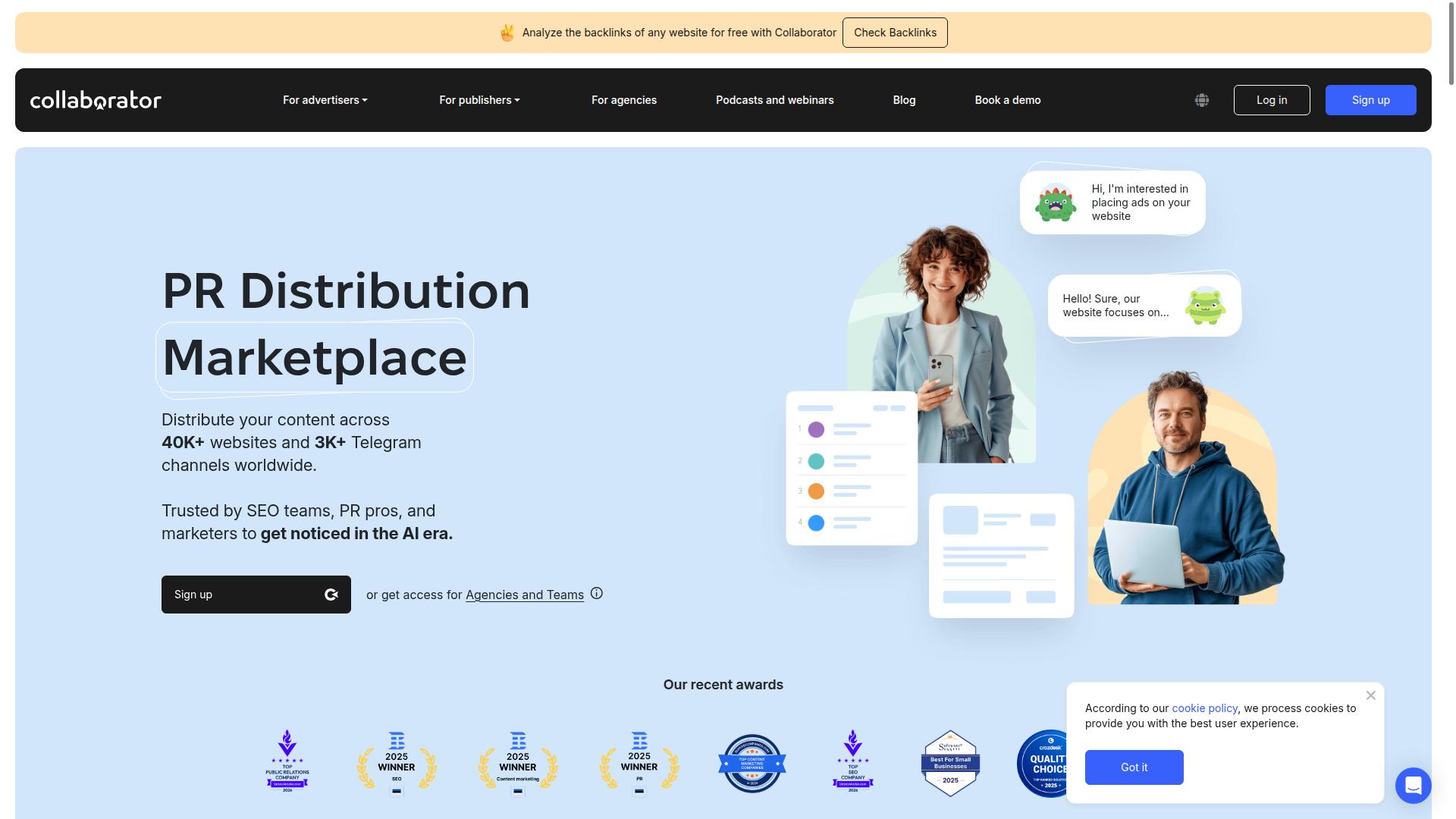
Collaborator offers basic placement management but lacks the multi-dimensional analytics found in more comprehensive suites. Publishers using this platform can handle guest posting transactions, yet the system stops short of delivering detailed performance insights. The focus remains on matching advertisers with publishers rather than tracking campaign outcomes.
Many link building teams use the platform to coordinate outreach campaigns across international markets. The marketplace lists thousands of opportunities spanning different languages and regions. However, once a placement goes live, users receive limited feedback on how that content performs over time.
Advertisers seeking to measure ROI measurement or compare content performance across different sites find themselves relying on external tools. The absence of integrated analytics creates extra work for teams that need to prove campaign value. This gap becomes noticeable when managing multiple sponsored content placements simultaneously.
Publisher Tools Comparison
Feature parity stops at campaign calendars and basic traffic snapshots. The platform provides a dashboard for viewing active placements and their status, yet deeper engagement data remains outside the system. Publishers cannot drill into audience demographics or track how readers interact with sponsored articles.
| Feature Category | Collaborator | Advanced Analytics Platforms |
|---|---|---|
| Dashboard Widgets | Placement status, basic traffic counts | Engagement rates, conversion tracking, domain authority filters |
| Export Formats | Standard reports | CSV, PDF, scheduled email delivery options |
| Alert Options | Email notifications for new requests | Real-time CPM rate changes, traffic threshold alerts |
Platforms offering granular engagement data allow publishers to filter placements by domain authority and monitor session duration trends. These additional metrics help teams prioritize high-performing partnerships. The contrast highlights why some publishers supplement Collaborator with separate analytics solutions.
Reporting Limitations
Collaborator's reports omit session duration, referral channel detail, and historical CPM trends. Publishers cannot see how long readers stay on sponsored pages or which traffic sources drive the most valuable visits. This missing information affects decisions about which sites deserve continued investment.
Without click-through rate per placement data, it becomes difficult to identify underperforming content that needs optimization. Domain authority filters are also absent, making it challenging to compare results across sites of varying quality. Audience demographic breakdowns would further help publishers understand who engages with their sponsored articles.
These gaps directly impact monetization decisions because publishers lack the visibility needed to negotiate better rates or drop low-performing partnerships. Teams often turn to external SEO metrics tools to fill these reporting voids. The limitations become especially apparent when managing large-scale guest posting campaigns that require detailed performance tracking.
How to Choose the Right Option
Selecting a platform requires matching your campaign volume, reporting depth, and existing tech stack to available feature sets. The decision process centers on three practical checkpoints that keep evaluation time short.
First, identify the publisher metrics you track weekly. Second, list every CMS and analytics tool already in use. Third, score each alternative platform on how many of your required fields it covers.
This three-step method prevents feature overload and focuses attention on platforms that deliver usable data for link building and content marketing campaigns.
Evaluating Your Metrics Needs
Map your internal KPIs, organic traffic share, social referral percentage, conversion events, to the depth of data each platform supplies. The table below turns this mapping into a simple worksheet.
| Metrics Needed | Available Data Fields | Priority (1-5) |
|---|---|---|
| Organic search impressions | Impression data, keyword ranking | |
| Referral traffic sources | Referral sources, session duration | |
| Conversion tracking | Conversion tracking, revenue tracking | |
| Backlink profile depth | Backlink profile, domain authority | |
| Audience demographics | Audience demographics, engagement rates |
Assign each metric a priority score from 1 to 5. Higher scores mark data you need every week. Lower scores flag nice-to-have fields that do not block campaign decisions.
Once scores are set, compare the totals against each alternative platform. The platform with the highest sum of priority matches becomes your shortlist leader.
Integration Requirements
Check API availability and native connectors for Google Analytics 4, Tag Manager, and your CMS before committing. The following endpoints cover the minimum data flow for accurate publisher metrics.
- Impressions pull for daily campaign visibility
- Click post-back URLs for conversion attribution
- Revenue sync for ROI measurement
Run the short compatibility checklist below to confirm your current stack works without custom code.
- WordPress sites: verify the native plugin supports scheduled data pulls
- Shopify stores: confirm order-level revenue fields map to the platform dashboard
- Custom stacks: test REST or GraphQL endpoints for impressions and clicks
Platforms that pass all three endpoint tests reduce setup time and keep campaign analytics reliable from day one.
Final Verdict
Publishers seeking unified placement, engagement, and revenue analytics should prioritize platforms that deliver all three in one dashboard.
WhitePress(r) stands out because it combines global placement access with real-time traffic and revenue metrics for publishers focused on measurable ROI. This approach helps content teams track campaign performance without switching between multiple tools.
Most alternatives to Adsy offer solid placement networks or basic analytics, yet few integrate both into a single publisher dashboard. The ability to view SEO metrics, traffic sources, and revenue tracking together reduces reporting time and improves decision accuracy.
Expert opinion suggests that publishers who need detailed performance data will benefit from platforms that maintain transparency across all three areas. WhitePress(r) positions itself as an effective choice for those managing sponsored content and guest posting campaigns.
The platform provides a solution for publishers who want to monitor ROI across placement, engagement, and revenue simultaneously. This unified approach addresses common pain points when comparing multiple alternative platforms for publisher metrics tracking.
Recommended Resources: